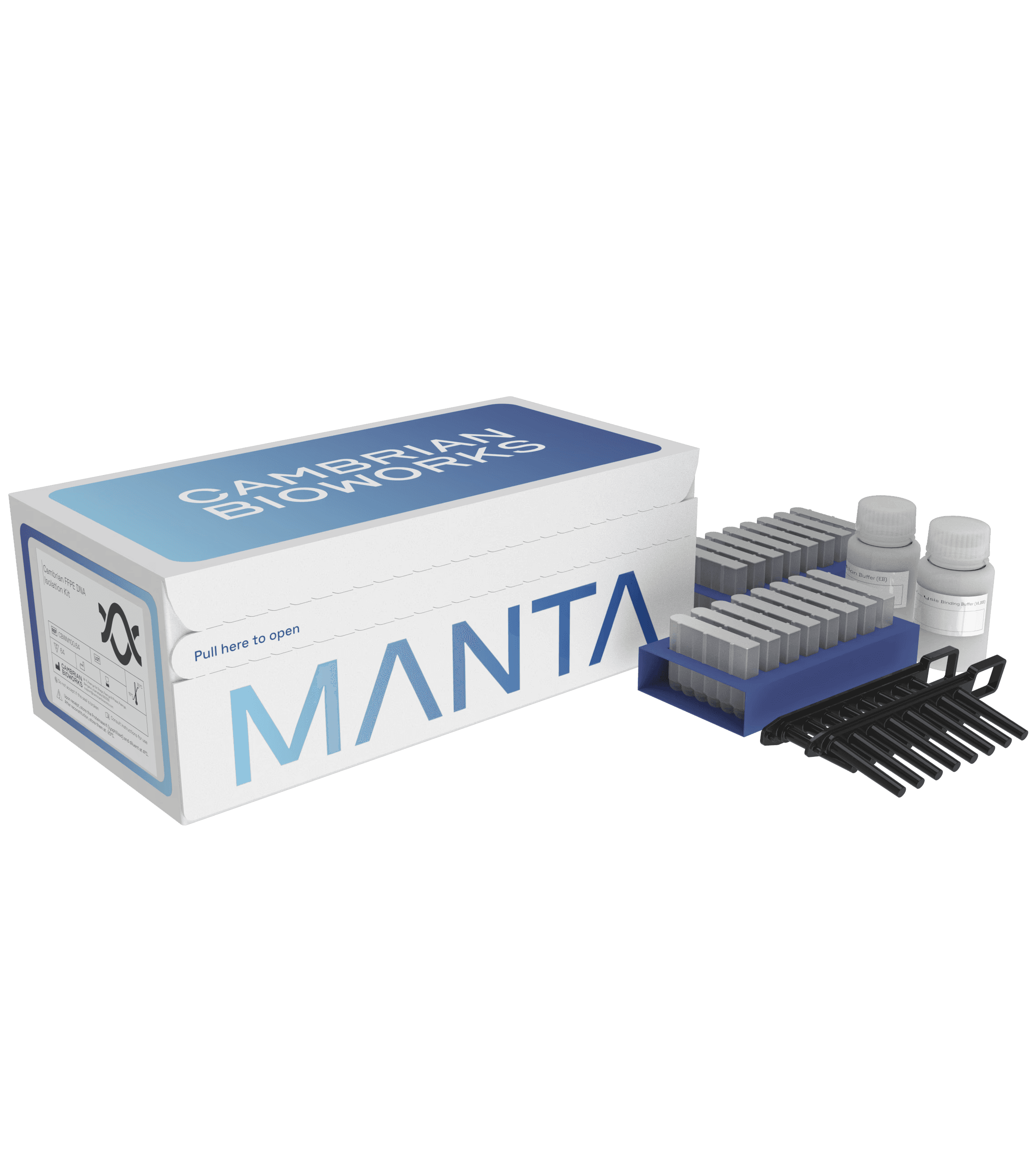

Cambrian FFPE gDNA Isolation Kit
Built for FFPE variability. Designed for consistent results
Available pack size:
50 reactions
50 reactions
50 reactions
250 reactions
250 reactions
250 reactions


Get reliable DNA from
FFPE samples
Get reliable DNA from
FFPE samples
Engineered for DNA
precision
Get reliable DNA from
FFPE samples
FFPE samples are the most widely used clinical specimens in oncology, but extracting sequencing-grade DNA from them is often unreliable due to variability in fixation and processing.
Our kit uses bead-based chemistry to consistently recover high quality DNA even at low tumor content (~10%), with broad fragment coverage (200 bp–48.5 kbp) and strong DIN values, making it ready for NGS and PCR workflows.
Consistency across
FFPE variability
Built for Indian FFPE samples
Optimized to handle variability in paraffin and formalin quality across regions
Consistent DNA quality
The kit delivers reliable DNA extraction across variable FFPE blocks
Flexible lysis options
Choose between 2-hour or overnight lysis (16 hr) based on workflow needs
Safer deparaffinization
The kit uses mineral oil for deparaffinization, eliminating the need for a fume hood and enabling a non-toxic, safer workflow
Designed for oncology workflows
Supports CGP, Oncomine, TSO, and custom oncology panels
Enabling a wide range of oncology
workflows from FFPE samples
The Cambrian FFPE gDNA Isolation Kit supports high-quality DNA extraction for a broad set of downstream applications, including:
Somatic mutation profiling
Analysis of key genes such as
TP53
TP53
KRAS
KRAS
EGFR
EGFR
BRAF
BRAF
Germline variant analysis
Identification of variants from tumor DNA such as
BRCA1/2
BRCA1/2
MLH1
MLH1
Comprehensive genomic profiling (CGP)
Multi-gene panels assessing mutations, fusions, CNVs, MSI, and TMB
Tumor mutational burden (TMB) assessment
Used in immunotherapy response evaluation like
PD-1
PD-1
PD-L1
PD-L1
Microsatellite instability (MSI) testing
Relevant for colorectal cancer and immunotherapy eligibility
Fusion gene detection
This includes fusions like
ALK
ALK
ROS1
ROS1
RET
RET
NTRK
NTRK
Copy number variation (CNV) analysis
Detection of amplifications like
HER2
HER2
MET
MET
EGFR
EGFR
and deletions like
and deletions like
CDKN2A
CDKN2A
PTEN
PTEN
Retrospective cohort and biomarker studies
Leveraging archival FFPE samples for translational research
Tumor heterogeneity studies
Understanding clonal variation and resistance mechanisms
Somatic mutation profiling
Analysis of key genes such as
TP53
KRAS
EGFR
BRAF
Copy number variation (CNV) analysis
Detection of amplifications like
HER2
MET
EGFR
and deletions like
CDKN2A
PTEN
Microsatellite instability (MSI) testing
Relevant for colorectal cancer and immunotherapy eligibility
Comprehensive genomic profiling (CGP)
Multi-gene panels assessing mutations, fusions, CNVs, MSI, and TMB
Tumor heterogeneity studies
Understanding clonal variation and resistance mechanisms
Tumor mutational burden (TMB) assessment
Used in immunotherapy response evaluation like
PD-1
PD-L1
Germline variant analysis
Identification of variants from tumor DNA such as
BRCA1/2
MLH1
Retrospective cohort and biomarker studies
Leveraging archival FFPE samples for translational research
Fusion gene detection
This includes fusions like
ALK
ROS1
RET
NTRK
Somatic mutation profiling
Analysis of key genes such as
TP53
KRAS
EGFR
BRAF
Tumor mutational burden (TMB) assessment
Used in immunotherapy response evaluation like
PD-1
PD-L1
Copy number variation (CNV) analysis
Detection of amplifications like
HER2
MET
EGFR
and deletions like
CDKN2A
PTEN
Germline variant analysis
Identification of variants from tumor DNA such as
BRCA1/2
MLH1
Microsatellite instability (MSI) testing
Relevant for colorectal cancer and immunotherapy eligibility
Retrospective cohort and biomarker studies
Leveraging archival FFPE samples for translational research
Comprehensive genomic profiling (CGP)
Multi-gene panels assessing mutations, fusions, CNVs, MSI, and TMB
Fusion gene detection
This includes fusions like
ALK
ROS1
RET
NTRK
Tumor heterogeneity studies
Understanding clonal variation and resistance mechanisms
Somatic mutation profiling
Analysis of key genes such as
TP53
KRAS
EGFR
BRAF
Tumor mutational burden (TMB) assessment
Used in immunotherapy response evaluation like
PD-1
PD-L1
Copy number variation (CNV) analysis
Detection of amplifications like
HER2
MET
EGFR
and deletions like
CDKN2A
PTEN
Germline variant analysis
Identification of variants from tumor DNA such as
BRCA1/2
MLH1
Microsatellite instability (MSI) testing
Relevant for colorectal cancer and immunotherapy eligibility
Retrospective cohort and biomarker studies
Leveraging archival FFPE samples for translational research
Comprehensive genomic profiling (CGP)
Multi-gene panels assessing mutations, fusions, CNVs, MSI, and TMB
Fusion gene detection
This includes fusions like
ALK
ROS1
RET
NTRK
Tumor heterogeneity studies
Understanding clonal variation and resistance mechanisms
Performance preview
Consistent DNA Quality
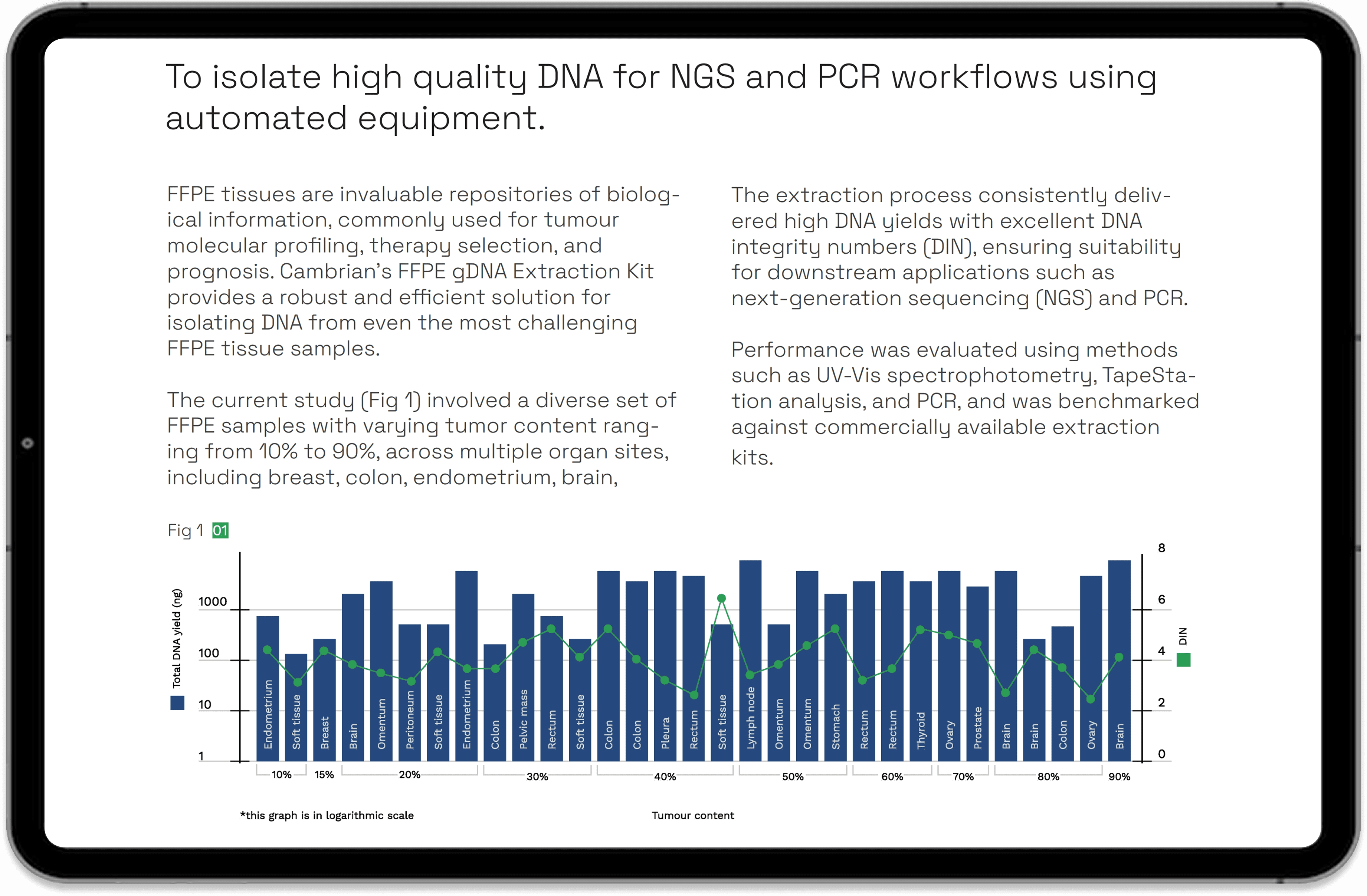
Across Tumor Variability
The dataset includes a diverse set of FFPE samples spanning multiple organ sites—breast, colon, endometrium, and brain with tumor content ranging from 10% to 90%. Across all samples, the extraction process consistently delivered high DNA yield and strong DNA integrity (DIN), ensuring suitability for downstream applications such as NGS and PCR.
Endometrium
Soft tissue
Breast
Brain
Omentum
Peritoneum
Soft tissue
Endometrium
Colon
Pelvic mass
Rectum
Soft tissue
Colon
Pleura
Rectum
Soft tissue
Lymph node
Omentum
Stomach
Rectum
Thyroid
Ovay
Prostate
Brain
Colon
Brain
1.00
10.00
100.00
1000.00
Note: This graph is in logarithmic scale
Total DNA yield (ng)
DIN
10%
15%
20%
30%
40%
50%
60%
70%
0
2
4
6
Tumour content
Peritoneum
Soft tissue
Breast
Brain
Omentum
Peritoneum
Soft tissue
Endometrium
Colon
Pelvic mass
Rectum
Soft tissue
Colon
Pleura
Rectum
Soft tissue
Lymph node
Omentum
Stomach
Rectum
Thyroid
Ovary
Prostate
10%
20%
15%
Tumour content
Note: This graph is in logarithmic scale
Total DNA yield (ng)
1.00
10.00
100.00
1000.00
30%
40%
50%
60%
0
2
4
6
DIN
Peritoneum
Soft tissue
Breast
Brain
Omentum
Peritoneum
Soft tissue
Endometrium
Colon
Pelvic mass
Rectum
Soft tissue
Colon
Pleura
Rectum
Soft tissue
Lymph node
Omentum
Stomach
Rectum
Thyroid
Ovary
Prostate
10%
20%
15%
Tumour content
Note: This graph is in logarithmic scale
Total DNA yield (ng)
1.00
10.00
100.00
1000.00
30%
40%
50%
60%
0
2
4
6
DIN
Illumina’s Infinium HD FFPE QC
The Infinium HD FFPE QC Assay was used to measure Cq values, where lower Cq (typically <29 cycles) indicates higher target DNA. The samples showed a QCT value of 13.6, with delta Cq consistently below 5 (per Illumina protocol), confirming excellent DNA quality suitable for sequencing.
Sample
Sample
Sample
A
A
A
B
B
B
C
C
C
D
D
D
E
E
E
Cq
Cq
Cq
11.9
11.9
11.9
14.7
14.7
14.7
13.2
13.2
13.2
12.8
12.8
12.8
12.2
12.2
12.2
Delta Cq
Delta Cq
Delta Cq
-1.7
-1.7
-1.7
1.1
1.1
1.1
-0.4
-0.4
-0.4
-0.8
-0.8
-0.8
-1.4
-1.4
-1.4
Technical specifications
FAQs
FAQs
FAQs
Ordering information
Product
Product
SKU
SKU
Pack Size
Pack Size
Workflow Type
Workflow Type
Product
SKU
Pack Size
Workflow Type
Product
SKU
Pack Size
Workflow Type
Cambrian FFPE gDNA Isolation Kit
CBWC100.50
50 reactions
50 reactions
50 reactions
Manual
Cambrian FFPE gDNA Isolation Kit
CBWC100.250
250 reactions
250 reactions
250 reactions
Manual
Cambrian FFPE gDNA Isolation Kit for Manta
CBWM100.64
64 reactions
64 reactions
64 reactions
Semi-automated (Manta)
Make FFPE extraction reliable
Handle variability with confidence and get consistent DNA from every block.