JSS Hospital supports a broad range of research and diagnostic genomics workflows, including whole genome sequencing, transcriptomics, Sanger sequencing, expression studies, microarray, and NGS.
The lab processes diverse sample types including blood, tissue, FFPE, and stool. Among them, stool samples posed the biggest operational challenge. Their complexity and variability made manual extraction difficult, time-intensive, and highly dependent on technician handling.
With 300-500 samples processed every month, the pressure on the four-member technical team continued to grow. The lab needed an extraction workflow that could handle diverse sample types efficiently without adding operational strain.
“Manual extraction was lengthy and time-consuming, especially for stool samples. Manta helped make the workflow easier to manage while supporting low elution volume requirements for downstream applications.” says Dr Jyothi M N
A user-friendly extraction system that fit into existing workflows
The lab adopted Manta, the DNA/RNA automation system, to make routine nucleic acid extraction more manageable across different sample types and downstream applications.
Manta was valued for three reasons: it was user-friendly, it helped reduce manual workload, and it supported low elution volume workflows. Low elution volume was important for downstream applications where nucleic acid concentration matters, including NGS, Sanger sequencing, transcriptomics, and expression studies.
The system fit into the lab’s existing workflow without requiring a major change in how samples were processed downstream. Instead of relying only on lengthy manual workflows, the lab could shift routine extraction steps onto a benchtop automation system while maintaining flexibility across sample types.
“We are very happy with Manta. It is very user-friendly and has helped reduce the manual pressure in our extraction workflow.” says Dr Jyothi M N.
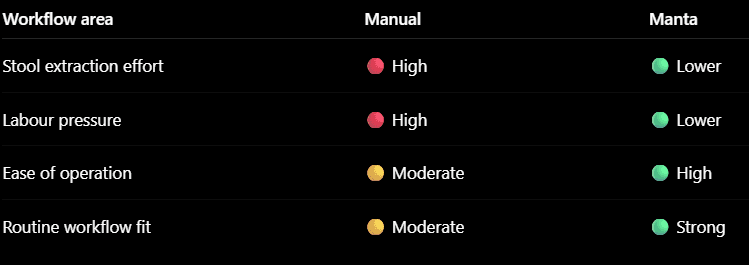
The transition from manual extraction to Manta reduced workflow complexity across the lab’s routine genomics operations. Stool extraction became easier to manage, labour pressure on technicians decreased, and the overall workflow became more streamlined for high-volume sample processing.
Reduced manual burden across 300-500 monthly samples
After three months of Manta use, the lab was able to simplify its nucleic acid extraction workflow and reduce pressure on technicians.
The biggest operational change was the reduction in manual workload. Previously, technicians had to spend significant hands-on time managing lengthy extraction steps, especially for difficult sample types such as stool. With Manta, the extraction process became easier to run and more predictable.
For a lab processing 300-500 samples per month, even small reductions in hands-on effort per sample can create a meaningful operational impact. Manta helped the team manage daily extraction needs more comfortably while supporting ongoing institutional and government-funded projects.
Continue reading…